Restrictive Interventions: Guidance for Educational Settings
Introduction
The issue of the use of restraint and seclusion in educational settings has emerged as an area of public interest, with a number of cases brought to public attention by parents and carers of children with lived experience.
At the request of the then Education Minister, Department of Education (DE) officials began a formal review of this area in early 2020. The Department subsequently published Interim Guidance on the Use of Restraint and Seclusion in Educational Settings in May 2021, whilst the review was ongoing. The overarching principle contained in the interim guidance was that the best interests of the child should guide all decisions taken by staff in relation to children in their care. The Department subsequently published a report on the Review of Restraint and Seclusion in Educational Settings in March 2022. One of the key recommendations contained in the report was that the Department should issue statutory guidance on the use of restrictive and supportive practices in educational settings.
In order to progress these recommendations, the Department engaged with the Working Group and Reference Group who had previously supported the review. This Working Group subsequently supported the development of the draft statutory guidance. Membership of the Working Group was drawn from a range of statutory bodies including the Education Authority, the Departments of Justice and Health, and the Public Health Agency. The Department also engaged with a Reference Group, made up of representatives from a range of key stakeholder organisations including NICCY, the Children’s Law Centre (CLC), the Equality Commission for Northern Ireland (ECNI) and the Northern Ireland Human Rights Commission (NIHRC). Further engagement also took place with other key stakeholders including teachers/staff from educational settings, teaching unions and parents of pupils with lived experience of these issues.
This work resulted in the draft Statutory Guidance on the Reduction and Management of Restrictive Practices in Educational Settings in Northern Ireland | Department of Education, which the Department published for consultation on 5 September 2023. The consultation closed on 10 November 2023. Stakeholders were broadly supportive of the development of statutory guidance and welcomed the opportunity to comment on the draft; however, there were a wide range of divergent views submitted and it proved challenging to identify areas of consensus on specific changes.
Overview of previous consultation
A total of 144 responses were received; 117 via the consultation booklet.
Respondents included school leaders (30%), teachers (19%), parents/guardians (18%), and others.
Breakdown of Respondent Types (from 117 questionnaire responses)
|
Option |
Total |
Percent |
|
Parent/Guardian |
21 |
17.9% |
|
Pupil |
1 |
0.8% |
|
School Leader |
35 |
29.9% |
|
Teacher |
22 |
18.8% |
|
Classroom Assistant |
6 |
5.1% |
|
Other School Staff |
0 |
0.00% |
|
School Governor |
2 |
1.7% |
|
Health and Social Care Staff |
1 |
0.8% |
|
Trade Union Representative |
4 |
3.4% |
|
Education Body |
3 |
2.6% |
|
Other Interested Member of the Public |
8 |
6.8% |
|
If Other, please specify |
14 |
12% |
|
Not Answered |
0 |
0.00% |
|
Total |
117 |
100% |
In terms of the key themes emerging from the previous consultation, there was broad support for statutory guidance. Respondents overwhelmingly agreed that statutory guidance is needed, especially for consistency and safeguarding. However, most believed the draft required significant revision before implementation.
There were strong and often conflicting views with stakeholders disagreeing on almost every major point—for example:
- Some felt the guidance protected staff over children; others believed the opposite.
- Supportive spaces and supportive practices were interpreted inconsistently.
- Parents with lived experience often opposed restraint entirely, while staff emphasised practical safety needs.
There were significant concerns raised by Special Schools. Special Schools consistently reported that the draft could not be implemented in its current form due to:
- High levels of daily crisis behaviour;
- Staffing and environmental constraints;
- Lack of specialist support from EA and health colleagues; and
- Excessive recording/administrative requirements.
There was confusion between “Restrictive” and “Supportive” practices. Many worried the definitions are unclear or risk being misused with some respondents believing that the distinction creates unnecessary burden. Others feared restrictive practices could be re‑labelled as “supportive” to avoid reporting.
There was some feedback on the lack of an outright ban to prohibit certain restrictive practices. A large proportion of respondents objected to:
- The absence of a ban on specific dangerous holds (e.g., prone restraint).
- The continued ability to use seclusion in crisis situations.
- Perceived misalignment with UNCRC expectations.
A significant portion of respondents objected to the draft because:
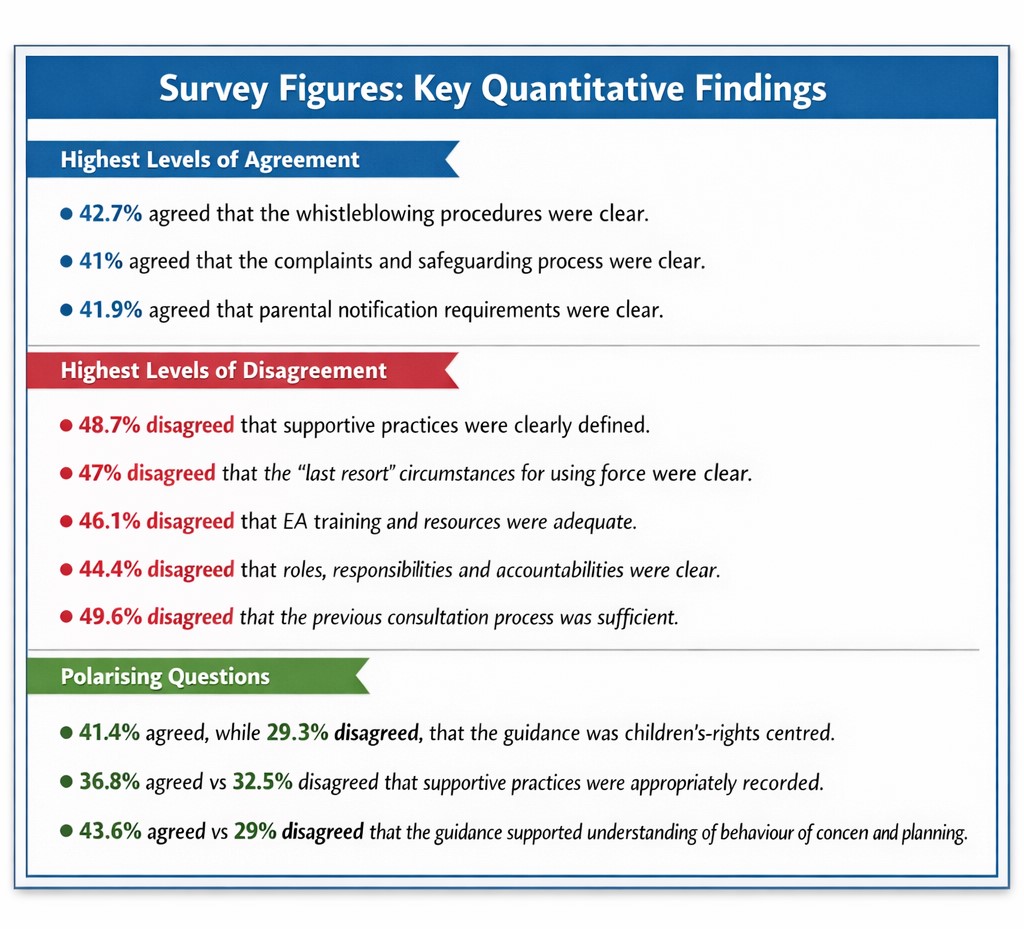
- 46–49% (depending on the question) felt the guidance did not go far enough in restricting the use of physical intervention.
- Many believed the absence of a ban on dangerous holds, such as prone restraint, created risk.
- Several respondents stated that allowing seclusion in crisis situations was unacceptable, with some calling for 100% prohibition of seclusion in educational settings.
- A notable group felt the guidance did not fully align with UNCRC expectations, with respondents emphasising that UNCRC requires restrictive practices to be used only as an absolute last resort and only to prevent immediate harm.
A number of respondents felt the draft guidance was not aligned with the Department of Health’s (DoH) regional policy, noting that:
- 34.2% disagreed that definitions were aligned with DoH and DoJ terminology, compared with 30% who agreed.
- Respondents highlighted that DoH uses a broader definition of restrictive practices, while DE’s definition is narrower and distinguishes “restrictive” from “supportive” practices.
- Many felt this difference could cause confusion or reduce consistency across sectors, especially where children are supported by both health and education services.
A number of respondents raised concerns around training and resources. This included criticism focused on the lack of detail on training standards, schools’ inability to access consistent EA support and no additional funding or staffing capacity to deliver or comply with the guidance.
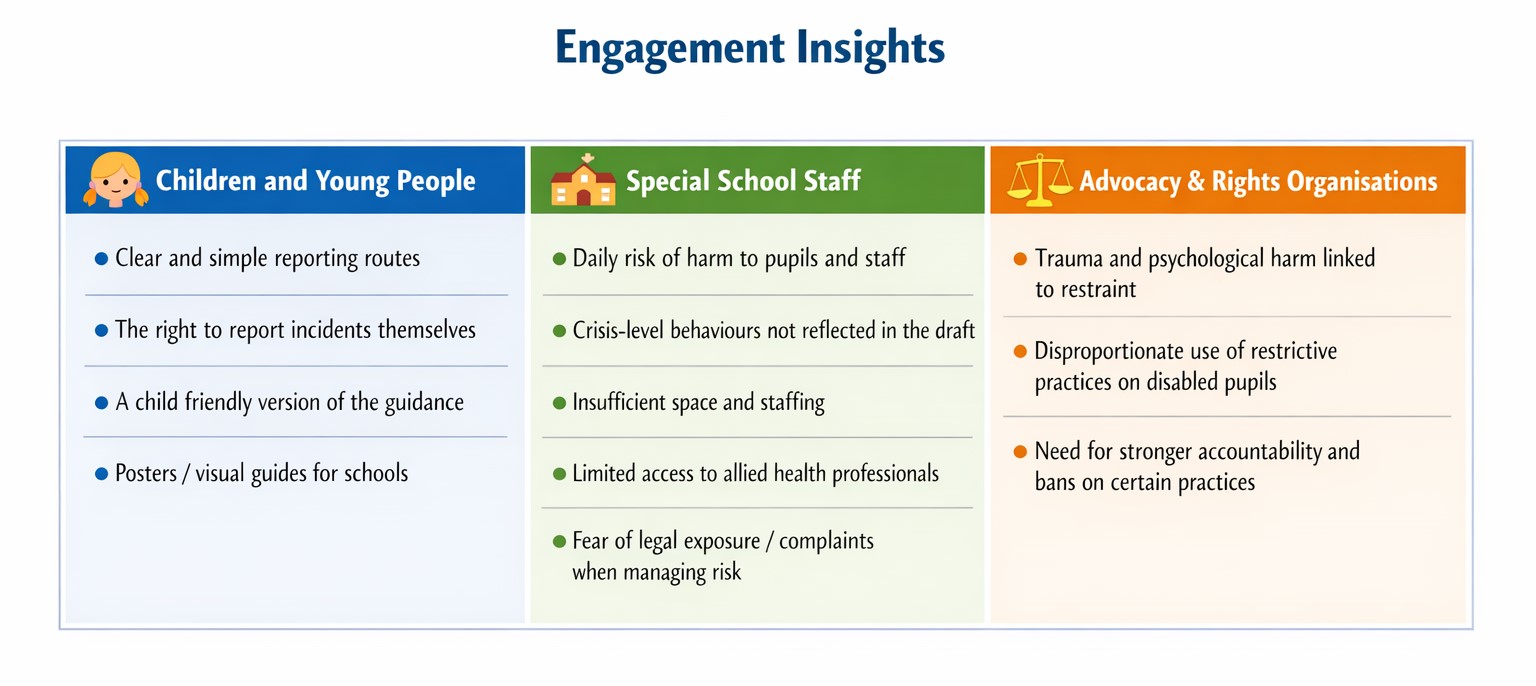
In summary, the consultation showed high support for statutory guidance, but limited confidence in the previous draft due to:
- Lack of clarity and consistency;
- Unworkability in special school contexts;
- Insufficient training/resources;
- Unclear definitions;
- Concerns over human‑rights alignment; and
- Strongly conflicting views on restraint, seclusion, and supportive practices.
Task and Finish Group
In light of this and at the Minister of Education’s request, a Task and Finish Group was established in December 2024, comprising education practitioners, health professionals, and children’s rights advocates, with the aim of revisiting the guidance, exploring the differing perspectives raised through the consultation, and working towards a revised version that better meets the needs of children and young people across the education system.
In the course of drafting the revised guidance, the Department engaged stakeholders through the Task and Finish Group. During the later stages of development, it became clear that the Department was unable to secure the breadth of cross‑sectoral engagement originally intended. In light of this, the Department considers it appropriate to proceed to public consultation to ensure that all relevant views could be captured in a transparent and inclusive manner.
A second consultation on this revised guidance, ‘Restrictive Interventions: Guidance for Educational Settings’ is therefore now being carried out to ensure the Department can gather a wider range of perspectives and provide all interested parties with an additional opportunity to contribute to the development of the guidance.
The purpose of the guidance is to provide clarity to educational staff on the use of restrictive interventions, particularly regarding the requirement to record and report serious incidents of physical restraint and all incidents of seclusion.
The guidance aims to reduce and minimise the use of restrictive interventions wherever possible, ensuring they are used only, in a proportionate, lawful, trauma‑informed and child‑centred manner.
The overall objective is to safeguard children and young people, promote their dignity and wellbeing, support inclusive practice, and ensure consistent standards across all educational settings.